How Non-Government Organisations in Australia Use Donations Effectively
- Share on
-

-

-


We’ve all been there—standing at a checkout or scrolling through a social feed, seeing a call to donate. In a country built on the concept of a “fair go,” the impulse to help is almost second nature.
But in 2026, with the cost of living biting harder than many of us ever expected, that impulse is often followed by a very reasonable hesitation: Is my ten or twenty dollars actually going to make a difference? When we look at the landscape of non government organisations Australia, the sheer number of charities—over 60,000 registered entities—can feel overwhelming.
Yet, it is this very network of ngo organisations in Australia that holds the safety net together when people fall through the cracks of official systems. Understanding how these funds are used isn’t just about being a “smart donor”; it’s about seeing the human story behind the statistics.
The Real-World Math of Giving: How NGO Organisations in Australia Work
There’s a common myth that most of your donations disappear into “admin.” While every organisation has lights to keep on, the most effective NGOs in Australia are incredibly lean.
According to the Australian Charities and Not-for-profits Commission (ACNC), the charity sector recently reported a total revenue of roughly $222 billion. A massive chunk of that comes from everyday people—about $19 billion in donations and bequests alone.
What’s truly impressive is how an NGO Australia can take a single donation and multiply its impact through volunteer labor and bulk resource management. They don’t just buy a loaf of bread; they partner with logistics chains to rescue tonnes of food. They don’t just buy a book; they set up a community library that serves hundreds of children.
Filling the Plate: The High Cost of Hunger
It’s a tough reality to swallow, but hunger is a growing shadow in our local communities. Data from 2025 and early 2026 suggests that roughly 1 in 8 Australian households have experienced food insecurity recently.
We aren’t just talking about “going a bit hungry”; we’re talking about parents skipping three meals a row so their kids can have a lunchbox to take to school.
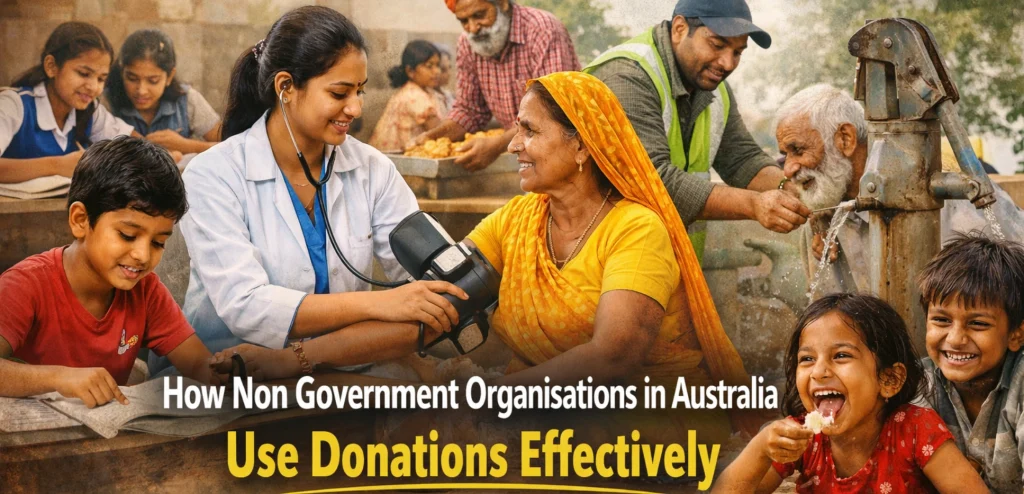
When you support an NGO in Australia focused on food relief, your money is used to tackle two sides of the same coin: immediate survival and long-term nutrition.
- Community Kitchens: These aren’t just about a “handout.” They provide a warm, safe space where the underprivileged can get a nutritious, hot meal. It’s about dignity as much as it is about calories.
- Food Hampers: For families on the brink, a weekly hamper of staples—rice, flour, fresh veg, and milk—is the difference between keeping the power on and going into debt.
- Emergency Relief: When a sudden financial hit happens, Australian NGOs are the first responders, providing immediate food vouchers or supplies to bridge the gap.
Education: Giving Kids a Head Start, Not Just a Handout
We often talk about education being free, but any parent knows that “free” is a relative term. The cost of a new uniform, a functioning laptop, or even just the basic stationery for a high schooler can easily run into the hundreds. For a family living below the poverty line, these costs are a wall.
Australian NGOs in the education sector focus on tearing that wall down. They use donations to ensure that a child’s postal code doesn’t determine their potential.
- Uniform and Kit Distribution: Walking into school on the first day in a brand-new uniform gives a child a sense of belonging that is hard to put a price on.
- After-School Support: Many underprivileged children don’t have a quiet place at home to study or a parent who can help with complex homework. Donations fund tutoring centers where these kids get the extra push they need.
- Vocational Training: For older youth, ngo organisations in Australia provide free courses in IT or tailoring. This isn’t just school; it’s a career path.
Restoring the Right to Move: Artificial Limbs and Mobility Aids
Perhaps the most visceral impact of a donation can be seen in the lives of the differently-abled. Imagine for a moment that you lost a limb due to an accident or a medical condition.
In a wealthy society, you might expect a replacement. But for the underprivileged, a prosthetic limb is a luxury they could never dream of—with costs often reaching $10,000 to $20,000 for high-quality mobility.
This is where a specialized Australian ngo truly shines. They use public support to manufacture and fit artificial limbs for free.
- Corrective Surgeries: Sometimes, mobility is lost due to a condition that can be fixed. Donations fund the surgeons, the theatre time, and the recovery care.
- Prosthetic Fitting: Every limb must be custom-fitted. This requires technicians and physical therapists, all funded by the generosity of donors.
- Mobility Tools: For some, an artificial limb isn’t the answer, but a sturdy wheelchair or a hand-cranked tricycle is. These tools turn a person who was confined to their home into someone who can go to the market, visit friends, and find work.
When a person gets their mobility back, they aren’t “disabled” anymore; they are “specially abled” and ready to contribute to society.
A Shining Example: Narayan Seva Sansthan
If you want to see exactly how this looks in practice, you only have to look at the work of Narayan Seva Sansthan. The organisation has become a global benchmark for what it means to use donations with absolute focus and heart.
Narayan Seva Sansthan’s stats for 2026 are nothing short of a miracle. NSS have performed over 450,000+ free-of-cost corrective surgeries for people with physical challenges. Imagine filling a large stadium several times over—that is how many lives they have physically transformed.
How NSS Spend Your Support:
- Daily Surgeries: Team performs 50+ life-changing corrective surgeries.
- Artificial Limb Workshops: Designed, built, and fitted in-house—custom limbs that restore mobility every day.
- Massive Feeding Programs: They provide free meals to people daily, ensuring that patients and their families don’t have to worry about hunger while they heal.
- Residential Academies: They run schools for underprivileged and orphaned children, providing a safe place to sleep, eat, and learn.
By choosing to support an Australian NGO like Narayan Seva Sansthan, you are directly funding a specific surgery, a specific meal, or a specific child’s school year. That is transparency in action.
The Bottom Line: Why We Give
At the end of the day, non government organisations Australia are only as strong as the people who back them. We don’t give because we have too much; we give because we know what it’s like to need a hand. Whether it’s the $5 we put in a bucket or the $50 a month we pledge, that money is the fuel for a more compassionate world.
When you see a child in a remote area log onto a computer for the first time, or a grandfather walk across a room on a new prosthetic leg, you aren’t just seeing “charity work.” You are seeing the very best of the human spirit, made possible by a simple, selfless act of giving.